FESCO Privatisation 2026: What It Means for Bills
Twelve investor groups have bid for FESCO. None of them will set your electricity rate. The per-unit tariff on a Faisalabad bill is determined by NEPRA and notified by the federal government, and that does not transfer with the shares. If FESCO is sold, the company changes owner — not the rate schedule. That is the answer most coverage skips, so start there and work outward.
Where the transaction actually stands
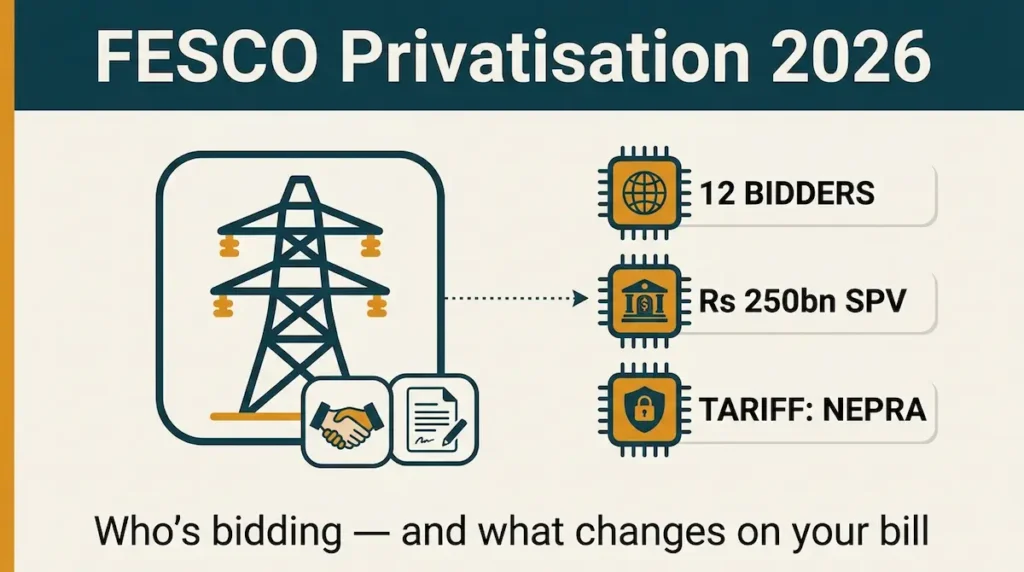
On 7 August 2026 the Privatisation Commission closed the first stage with 12 Expressions of Interest for 51% to 100% shareholding in FESCO together with management control — three from Türkiye, one from China and eight from Pakistan.
The named parties include Engro Energy, Sapphire Fibres, Hub Power Holdings with Lucky Cement, Shirazi Investments, Nishat Mills with Pak Elektron, and Artistic Milliners with K-Electric. JDW Sugar Mills joined a Pakgen-led consortium on 20 August, amending its Statement of Qualification.
Submissions are now evaluated against approved prequalification criteria; those that qualify get access to a Virtual Data Room for detailed due diligence.
Two sister transactions frame the pace. GEPCO closed on 21 August with 11 EOIs, four of them foreign, and most of those groups had already bid for FESCO. IESCO’s deadline is 7 September 2026.
No bid has been submitted. No price exists. Prequalification is not a sale.
What does not change
Three things stay exactly where they are, regardless of who wins.
- Tariff. NEPRA determines it, the government notifies it, and the buyer applies it. K-Electric was privatised in 2005 and is still regulated like any other DISCO.
- Uniform pricing — for now. Muhammad Ali has said the privatised DISCOs will have a uniform tariff rather than a differential one. The stated plan is to maintain the uniform consumer tariff while pursuing efficiency gains, with a grievance redress mechanism during transition.
- Your reference number and meter. Ownership transfers do not reissue consumer records. If you want to confirm what you are being billed under today, check your FESCO bill and read the tariff category printed in the consumer box.
The one change that would move your bill
Investors are pushing on precisely the point that protects Faisalabad consumers.
Bidders have proposed replacing the uniform tariff with tariffs reflecting each DISCO’s own performance and efficiency, noting that consumers of an efficient utility such as FESCO currently pay the same base price as consumers in loss-making Sukkur and Peshawar.
Cut both ways, that argument is real. FESCO recorded 100% recovery of billed amounts in FY2025-26. Under a performance-linked structure, a low-loss territory could pay less than the national average — or a buyer could argue for a higher return in exchange for investment.
Investors have also sought a seven-to-ten-year control period instead of five, and inflation-adjusted guaranteed returns in foreign currency; the government appears reluctant on the currency link. The offer on the table is a 14–15% base return, rising to 18–20% through efficiency gains.
This is unresolved. Watch it more closely than the bidder list.
The Rs250bn SPV, and why it matters at your meter
The government plans a wholly owned Special Purpose Vehicle with Rs250bn authorised capital to take over Rs350.6bn in assets and Rs313bn in liabilities carved out of the three DISCOs, leaving Rs37.6bn equity, while FESCO’s own authorised capital rises to Rs100bn.
In plain terms: legacy debt and obligations are moved off the company so a buyer inherits a clean balance sheet.
One line inside it is consumer-facing. The government is expected to direct NEPRA to register the SPV along with a separate pension fund, so that pension liabilities of retirees can be recovered through electricity tariffs. Those obligations do not vanish at sale — they are routed to the tariff.
Realistic expectations
Loss reduction, metering upgrades and faster recovery are the levers a buyer can pull. Generation cost is not one of them, and generation is the bulk of what you pay. Efficiency gains at the distribution end can ease pressure on tariffs over years, not months.
Take the timeline seriously — and its history
FESCO was first offered for privatisation in 1998, then reactivated in February 2006, when twelve EOIs were also received. Both attempts stalled on tariff notification and unresolved conditions. That is not a prediction of failure; it is a reason to treat prequalification as stage one of many.