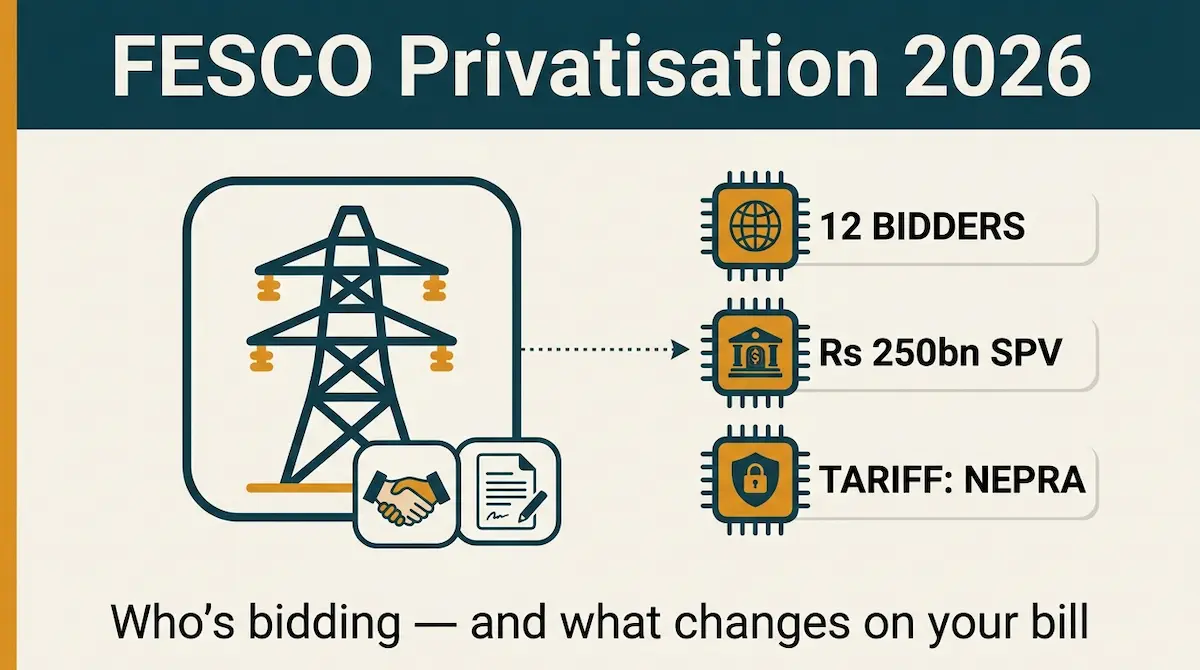
FESCO September Bill: Why It Will Be Higher
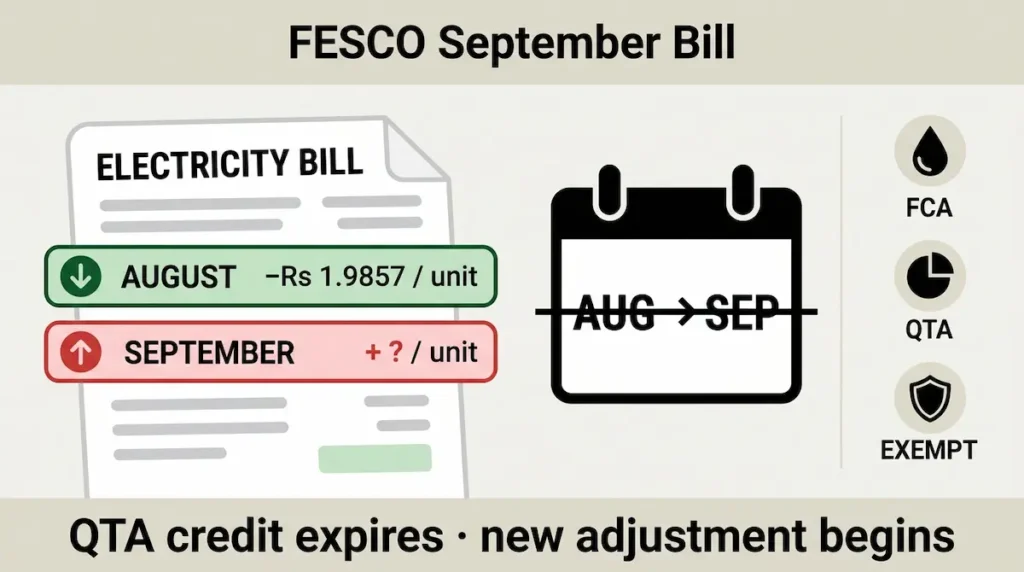
Your September FESCO bill will be higher than August’s for one reason most people miss: the Rs1.9857 per unit credit sitting on your bill right now expires after the August cycle. It was never permanent. It covered three billing months — June, July and August 2026 — and September starts without it.
That single change costs a 300-unit household roughly Rs596 in energy charges, before GST is applied on top.
The credit you’re losing
Look at your August bill and find the line marked QTR TARIFF ADJ (some printouts show it as Q.T.R or Quarterly Tariff Adjustment). Against it you’ll see a negative figure — money subtracted from your total. That is NEPRA’s settlement for the January–March 2026 quarter. The regulator approved a negative adjustment of Rs67.173 billion, passed back at Rs1.9857 per kilowatt-hour across June, July and August 2026 bills. Three months. Then it’s done. Nothing needs to be announced for it to disappear — expiry is built into the determination.
What replaces it
Two decisions have been finalised and notified, and both land on September invoices.
- The next quarterly adjustment (April–June 2026). This one is positive — money added, not returned. Distribution companies have sought recovery of around Rs34 billion, roughly Rs1.34 per unit, citing lower electricity consumption and higher capacity charges. The hearing was held on 12 August. NEPRA member Amina Ahmed said the higher impact for the April–June period had become inevitable, and IESCO told the regulator its September–November quarterly tariff needed to rise by about Rs1.83 per unit.
- The July fuel adjustment. CPPA-G has asked for Rs2.52 per unit, with NEPRA scheduling a public hearing for 27 August. Diesel-fired generation cost Rs54.48 per unit in July and imported coal Rs16.33 per unit.
The requested figures above have been superseded by final notified rates: Rs2.0581 per unit for July’s fuel adjustment and Rs0.5194 per unit for the April–June quarterly adjustment. The FCA applies to July’s billed units and is scheduled for September billing; the quarterly adjustment applies over September–November 2026. Where bills were issued before the relevant notification, recovery may occur in a subsequent month. NEPRA routinely approves less than requested — for May it allowed Rs0.3364 against Rs0.8173 sought, and for June it allowed Rs0.75 against Rs1.20 sought. Treat both numbers as ceilings, not certainties.
The arithmetic on your own bill
August’s two adjustment lines net out like this: minus Rs1.9857 (QTA) plus Rs0.7503 (June FCA) = Rs1.2354 subtracted per unit.
September starts from zero on the credit side. Even if the regulator halves both requests, the adjustment lines swing from negative to positive. On 300 units that is a difference of several hundred rupees before tax — with no change whatsoever in how much electricity you used. This is the part that generates complaints every quarter. The bill rises, consumption didn’t, and the meter gets blamed.
Who is exempt — and the detail everyone gets wrong
The two lines do not exempt the same people.
- Quarterly adjustment: excludes lifeline consumers, prepaid consumers, and units billed under the incremental consumption package.
- Fuel adjustment: excludes lifeline consumers, EV charging stations and prepaid consumers — but does apply to incremental-package consumption.
So an eligible industrial or private agricultural consumer on the incremental package received no benefit from the expiring credit, yet still pays the fuel line. Copy-paste articles list one exemption set for both. Check which line your exemption actually covers.
Read the September bill in this order
- Units consumed — compare against your own August figure first. If units are flat, the increase is regulatory, not metering.
- Energy charge — this follows your slab under the current schedule of tariff. If you want to cross-check the per-unit rate, see the FESCO tariff slabs breakdown.
- QTR TARIFF ADJ — confirm the sign. A positive number here is the new quarter, not an arrear.
- FCA line — this is July’s consumption month, billed two months late. That lag is normal and not an error.
- GST — applied on the adjusted amount, so a per-unit adjustment costs about 18% more than its face value.
An adjustment line is not a detection bill and not an arrear. Raising a complaint against it will not succeed, because FESCO applies the figure the regulator notifies. FESCO cannot waive it.
Dates worth watching
- 27 August 2026 — NEPRA hearing on the July fuel adjustment.
- Early September — determinations for both the fuel adjustment and the April–June quarterly adjustment were notified on 4 September 2026 and 7 September 2026, respectively.
- September to November 2026 — the recovery window for the new quarterly adjustment, meaning three consecutive bills, not one.
If you are close to the 200-unit protected threshold, this quarter is the wrong one to drift over it. The adjustment lines hit every unit you are billed for, and losing protected status multiplies the base rate underneath them.
Figures verified against NEPRA determinations and hearing records current to 22 August 2026. Pending items are marked as pending. Confirm final notified rates on your printed bill.